My dog ate poisonous mushrooms: what should I do?
In short
- Has your dog eaten a mushroom, or do you suspect so? Call your vet or the emergency vet service straight away, even if your dog shows no symptoms yet.
- Do not wait for symptoms: with some species, such as the death cap, they appear only after hours and your dog may seem to recover first.
- Take a photo of the mushroom and keep a piece (in a paper bag) so it can be identified.
- Do not try to make your dog vomit yourself, not even with salt water, and do not give milk, oil or other home remedies.
Mushrooms appear mostly in autumn in woods, meadows, parks and even on lawns. Most species are harmless, but a few are highly poisonous, and even experienced foragers do not always recognise them. Did your dog eat a mushroom you are not sure is harmless? Treat it as an emergency.
What to do straight away
- Move your dog away from the mushrooms and carefully remove any remains from its mouth.
- Call your vet immediately or, outside opening hours, the nearest emergency vet service. Say what your dog ate, when, how much, and how big and old your dog is.
- Take a photo of the mushroom and keep a piece in a paper bag so the species can be identified.
- Follow the vet’s advice. Never make your dog vomit yourself, not even with salt water: it can be dangerous. Do not give milk, oil or other home remedies either.
- Take your dog to the practice if the vet asks you to, even if it still seems fine.
Which symptoms can appear?
Symptoms depend on the species, the amount and the size of your dog. Some appear after a few minutes, others only after hours or days. A dog that first seems to recover can still become seriously ill later. Possible signs:
- vomiting, diarrhoea, drooling and abdominal pain;
- lethargy, weakness, unsteady walking or trembling;
- seizures;
- yellowing of the gums or skin, or bleeding (liver damage);
- in severe cases, coma.
Some poisonous mushrooms
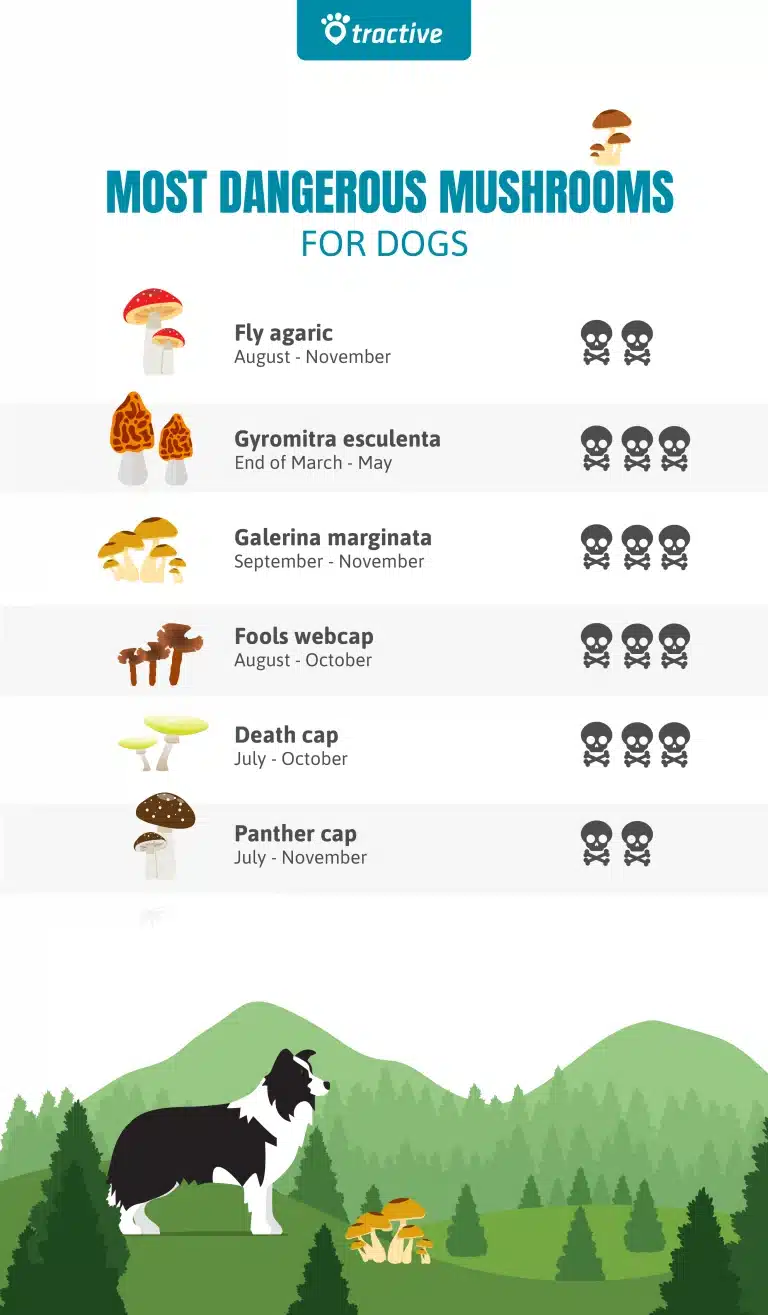
The illustration below shows some dangerous species, including fly agaric, death cap and panther cap. It is not complete: never use it to decide whether a mushroom is safe.
What will the vet ask?
- When did your dog eat the mushroom, and at what time?
- How much did it eat, and can you describe or show the mushroom?
- Is your dog already showing symptoms?
Treatment depends on the mushroom and the symptoms. The vet may, for example, induce vomiting, give medication or a drip, test blood and monitor your dog for a while.
How to prevent it
- In autumn and after rain, keep your dog on the lead or closely in sight in woods and meadows.
- Check your garden and lawn for mushrooms and remove them (wearing gloves) before your dog can reach them.
- Train ‘drop it’ and ‘leave it’: this helps with other hazards too. Read more about garden risks in our article on garden dangers.
- Similar symptoms can also come from foods that are toxic to pets.
Frequently asked questions
Is every mushroom poisonous to dogs?
No, but poisonous and harmless species can look very alike. If in doubt, treat a mushroom your dog ate as dangerous.
My dog ate a bit of mushroom and seems normal. Should I still call?
Yes. Call your vet: symptoms can be delayed and quick help makes a big difference.
Can I call the Poison Centre?
The Belgian Poison Centre (070 245 245) also answers questions about animals during limited hours, but gives priority to urgent calls about people. So call your vet or the emergency vet service first.
Last updated: 12 October 2026

Source: Tractive Blog